
04Real-time2026Solo — sync protocol, server, renderer, interface
Tessera — Multiplayer Whiteboard
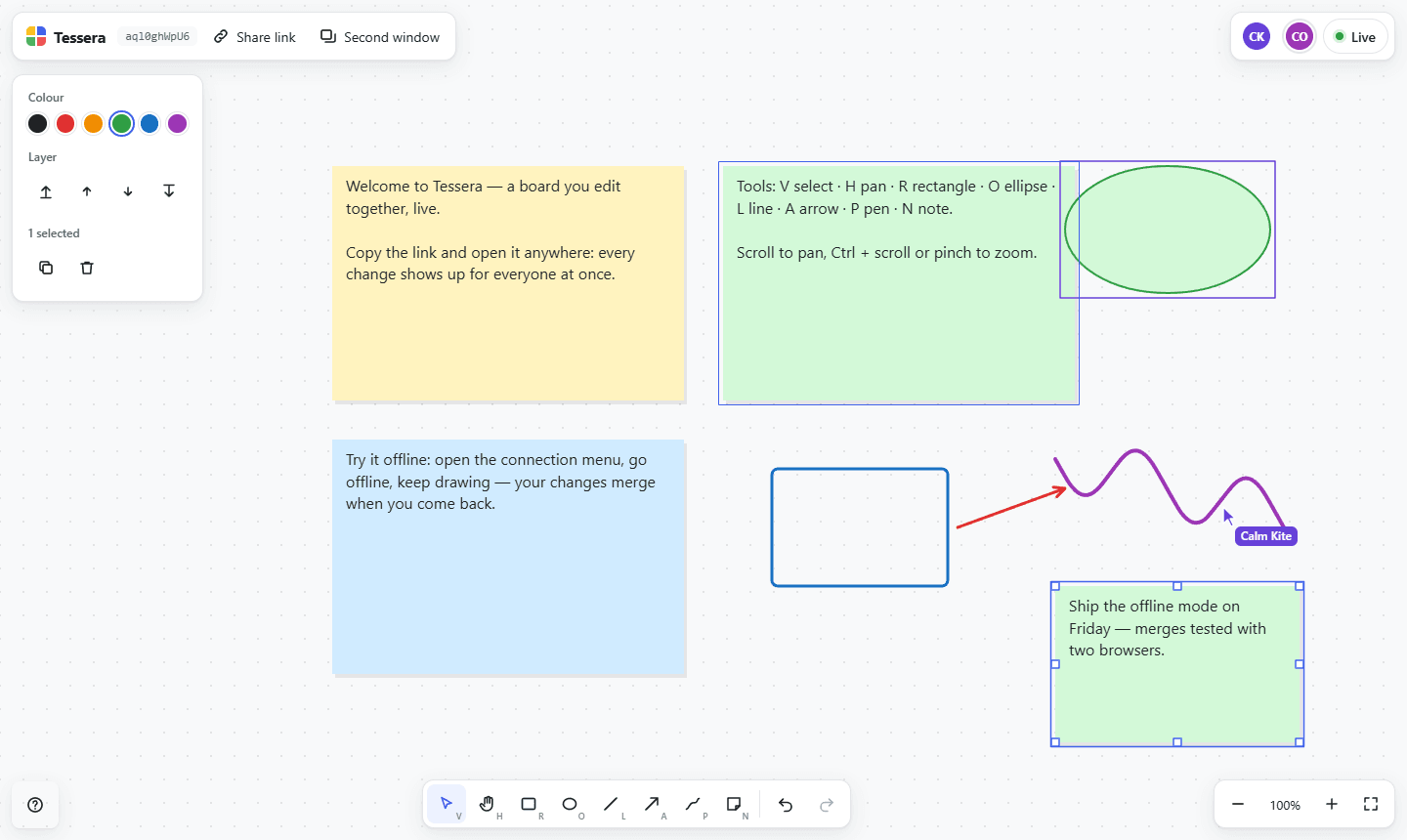
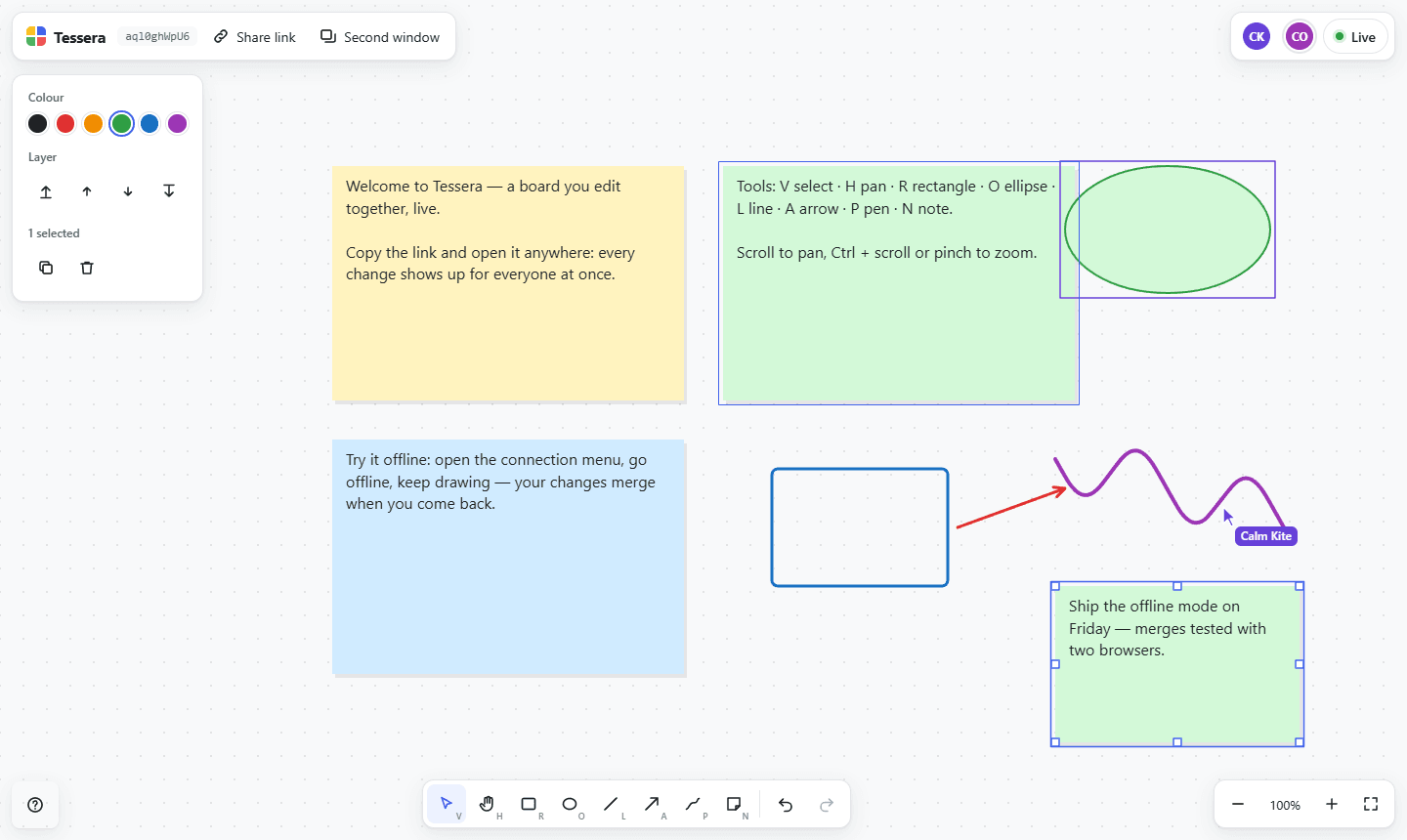
A shared canvas with live cursors, offline edits that merge on reconnect and per-person undo — with the sync written from scratch.
The problem
Quorum showed I can keep a little state in step between people. A whiteboard is the hard version of that: a large shared document, several people editing the same objects at once, and connections that drop in the middle of a drag. I wanted to build the synchronisation myself rather than hand it to a CRDT library or a realtime service — that is the part worth showing — and then test it hard enough to trust it.
Decisions
01
The server's only job is order
Each room is one Durable Object, and a Durable Object is single-threaded, so every change gets applied in one sequence and broadcast with its number. Conflicts resolve per property in that order: move a shape while someone recolours it and both survive. It is the model Figma describes for its own multiplayer, and for shapes it is enough — nobody types into the same word character by character, so there is nothing a sequence CRDT would add.
02
Instant, but never flickering
Each client keeps the server's board and its own view: the server's board plus its unacknowledged changes. A remote write to a property this client is still waiting to hear back about is not shown, because the server has already ordered it before ours — showing it in between would make the shape jump back and forth.
03
Exactly once, even after a reconnect
Every change carries its client's id and a counter. The room remembers the last counter it applied per client and says so when a client reconnects, so a change is never applied twice and never re-sent once applied. A client may only use the id it said hello with — otherwise one tab could advance another's counter and silently swallow its edits.
04
Offline is the same code path
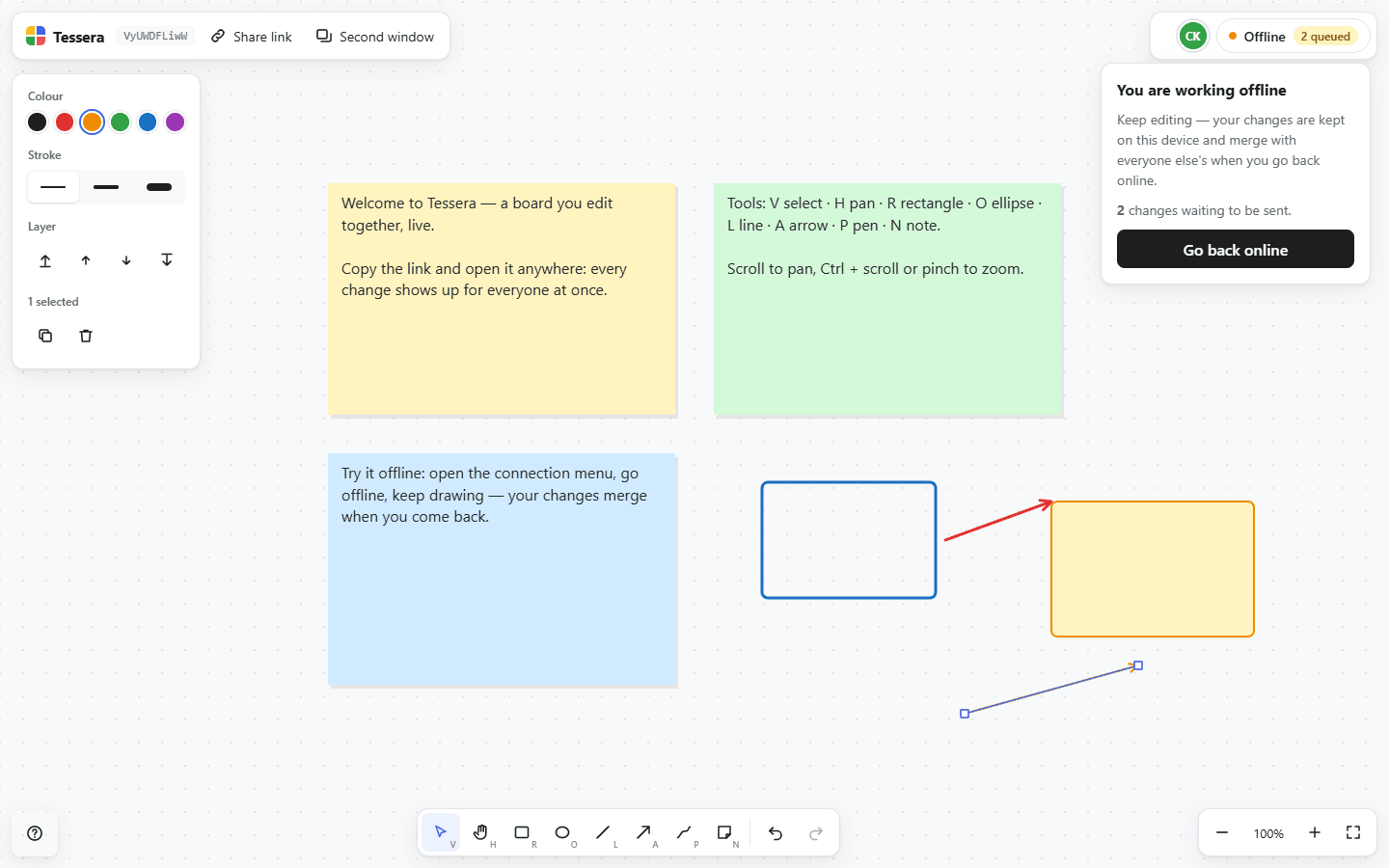
While disconnected, changes queue exactly as they do online, are also written to local storage so a reload keeps them, and go out on reconnect; the server's ordering then does the merging. The Go offline switch exists because browsers' own offline emulation does not reliably cut an open WebSocket — and a visitor should be able to try it without unplugging anything.
05
Layer order that never renumbers
Stacking order is a fractional index: there is always a key between two keys, so bringing a shape to the front rewrites that one shape. The first version used fractions only, and a test that kept putting new shapes on top pushed keys past the 64-character limit within a few hundred inserts. Keys now carry an integer part; ten thousand such inserts stay at four characters.
06
Measured the renderer before optimising it
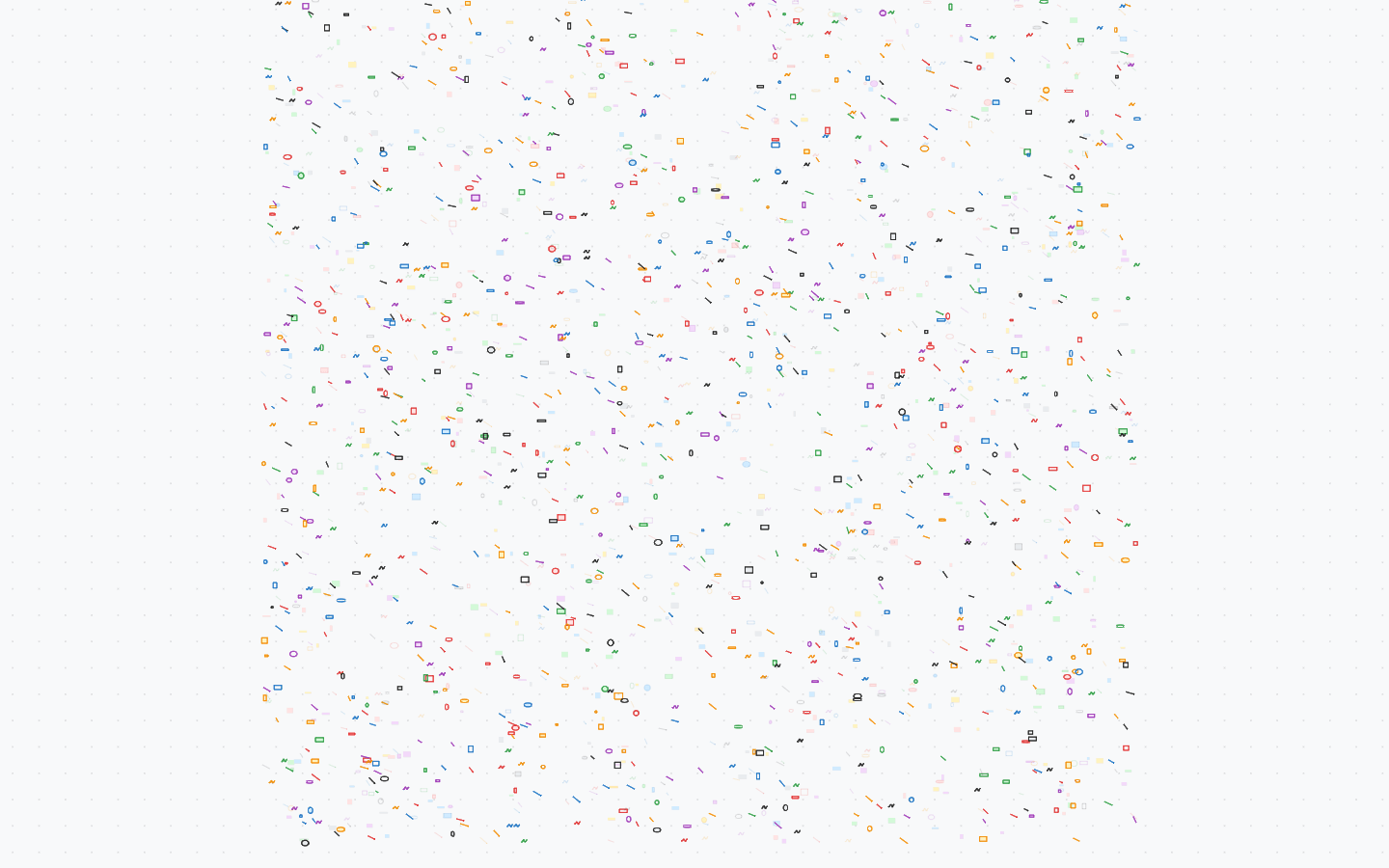
Ten thousand separate strokeRect calls took 1.8 ms of JavaScript and 34 ms of frame — every fill or stroke is its own operation for the GPU process. So above 800 visible shapes the renderer batches one path per style, a few dozen calls instead of ten thousand, and small or plentiful note text is drawn as grey bars, because fillText at a zoom that changes every frame rasterises every glyph again.
What I measured
120 × 500
simulated sessions × steps
2–4 clients, dropped connections, refused changes — every one converges
54 + 7
unit + end-to-end tests
each end-to-end test drives two browsers against the real Worker
5.6 ms
render at 10,000 shapes
JavaScript per frame, in batched mode
0
sync libraries
ordering, merging, offline and exactly-once are all in the repo
Built with
- React
- TypeScript
- Canvas 2D
- Cloudflare Workers
- Durable Objects